Teaching LaTeX templates
Every template compiles as it stands, from the publisher’s own package. Type your journal’s name below, browse by journal, or see conferences and their deadlines.
Teaching
Or start from a blank project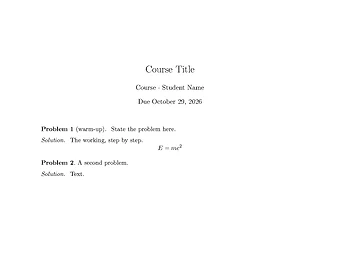
Assignment / problem set
TeachingNumbered problems with a solution block you can switch off for the handout.
Lecture notes
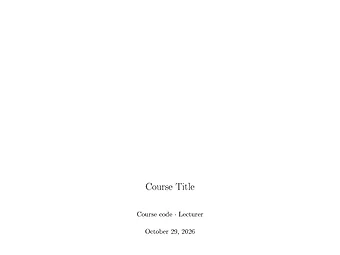
TeachingDefinitions, theorems, proofs and exercises, one chapter per lecture.
Midterm exam (exam)
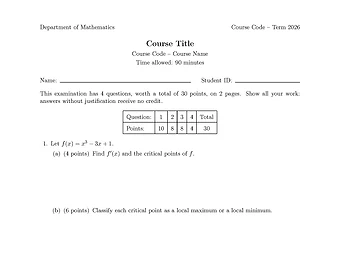
TeachingA midterm paper on the exam class with points per part, a point table on the first page and a grading table at the end.
Exam answer key (exam)
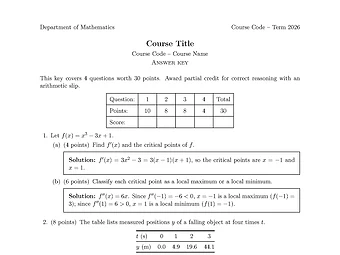
TeachingThe same exam class paper compiled with the answers option, printing framed solutions under every question.
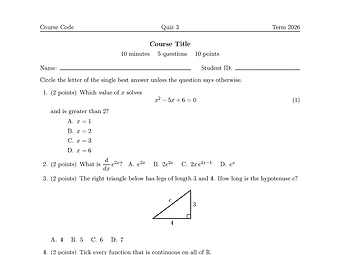
Multiple-choice quiz (exam)
TeachingA short quiz on the exam class using its choices, one-paragraph choices and checkbox environments.
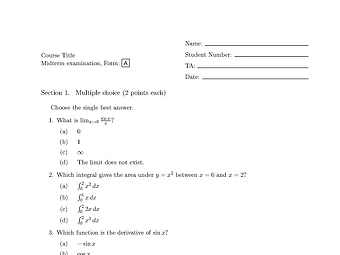
An exam in multiple-choice, true/false, fill-in and short-answer sections, typeset in two shuffled versions with an answer key for each.
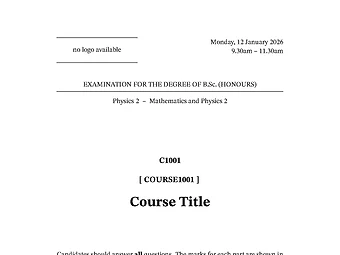
University exam paper (exam-n)
TeachingA degree examination paper with the class's required metadata, marks per part, a multiple-choice question and solutions for the draft version.
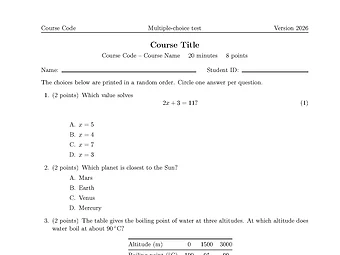
A multiple-choice test on the exam class whose answer choices are placed in a seeded random order, followed by a key table.
Exam from question banks (examz)
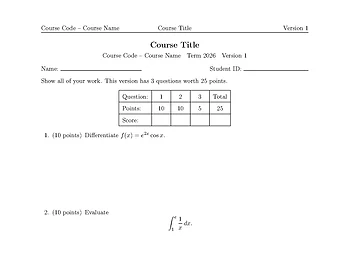
TeachingTwo versions of an exam built with examz, each drawing one question at random from separate question-bank files.
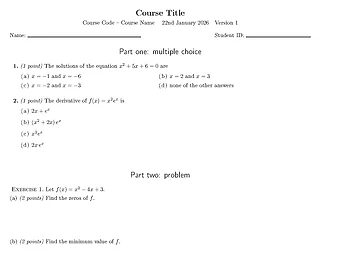
Several versions of an exam in one file, with multiple-choice questions and a problem whose variants and answer order are chosen per version.
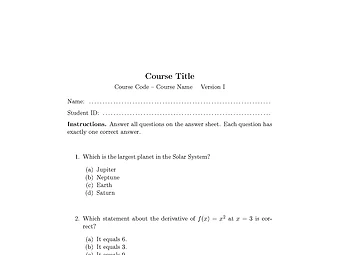
A multiple-choice exam whose question and answer order is permuted across four versions, with concept, exam, key and answers outputs.
Multiple-choice table (alterqcm)
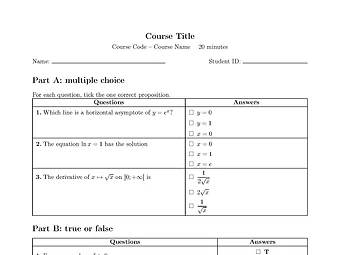
TeachingMultiple-choice and true/false questions set in two-column tables, with a second copy showing the correct answers.
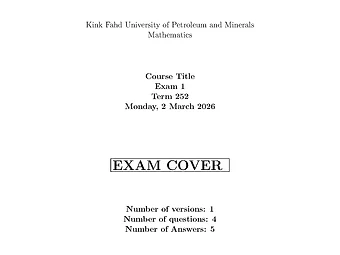
A multiple-choice mathematics exam in the style of the King Fahd University of Petroleum and Minerals mathematics department, with a cover page and a plotted graph.
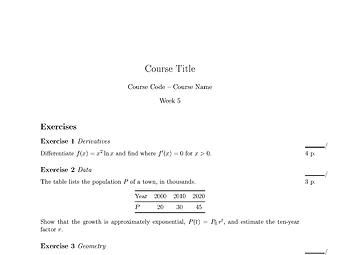
An exercise sheet with points per exercise, a grading table and the solutions collected at the end with xsim.
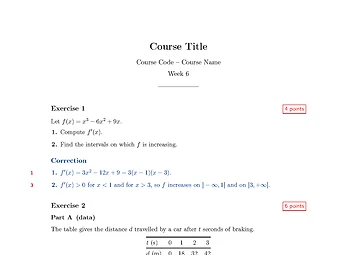
An exercise sheet on the exesheet class with question and answer blocks that can be shown or hidden, and a marking scheme in the margin.
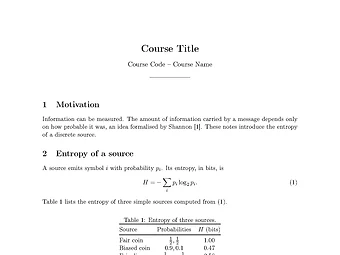
Course notes (schooldocs)
TeachingLecture notes on the article class with a schooldocs page style, title block, subject, institution and date in the headers.
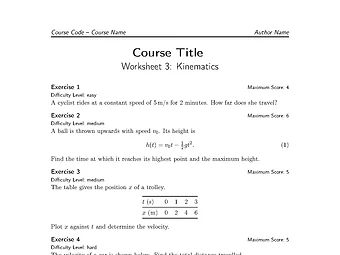
Worksheet (worksheet)
TeachingA worksheet on a KOMA-Script article with a title, course header and exercises showing their score and difficulty.
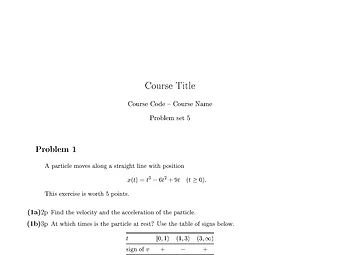
A problem set assembled from exercise files, selecting individual part problems, with points per part and solutions that can be switched on.
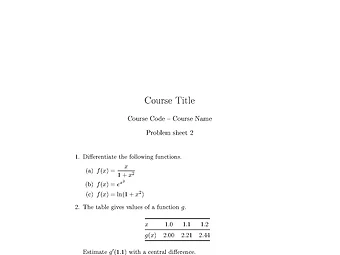
Random problem sheet (probsoln)
TeachingA problem sheet that draws problems at random from a problem file, followed by the same problems with their solutions.
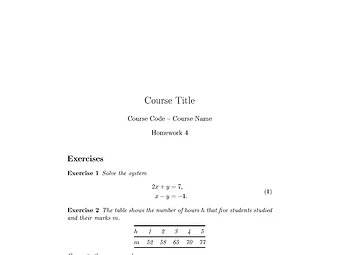
Homework exercises whose solutions are written to a separate file by the answers package and printed as an answer key at the end.
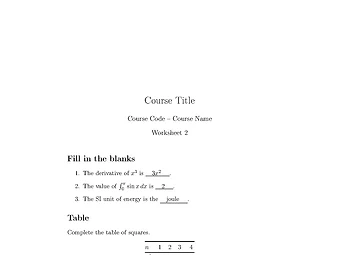
A worksheet whose answers and worked solution are shown or hidden by one switch, giving the question sheet and the answer sheet from one file.
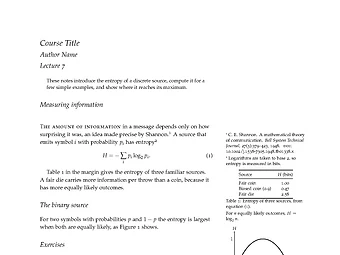
Lecture handout (tufte-handout)
TeachingA lecture handout on the tufte-handout class with side notes, a margin table and a margin figure.
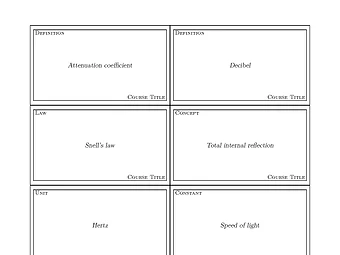
Flash cards (flashcards)
TeachingDouble-sided revision cards — term on the front, definition on the back — laid out for business-card sheets, in the flashcards class.
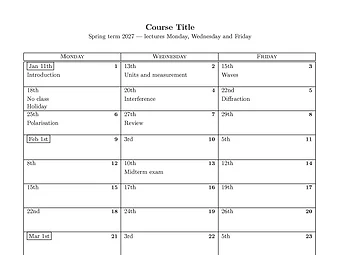
A week-by-week class calendar that numbers lectures, skips holidays and flows lecture topics around them, with termcal.
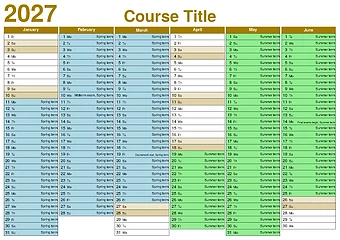
A one-page year calendar drawn with TikZ, with term dates, deadlines and holidays read from event files, in tikz-kalender.
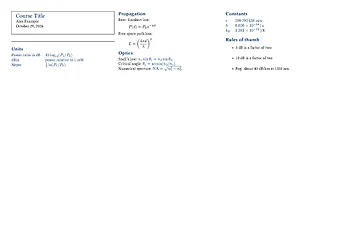
A dense landscape reference sheet in three columns with compact headings, from the cheatsheet class.
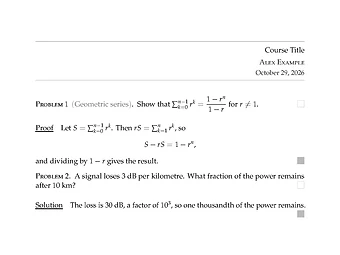
A homework write-up with numbered problems, solutions and proofs, and theorem-style statements, in the homework class.
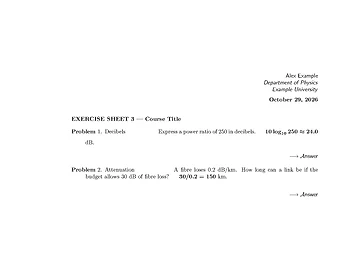
An exercise sheet with course title, label and semester in the header and a numbered problem list with answers, in the assignment class.
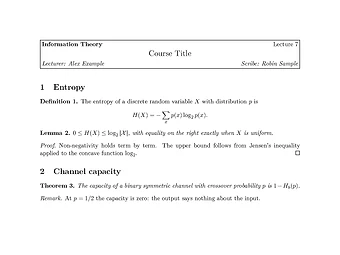
Scribe notes for one lecture: a boxed header with course, lecturer and scribe, then definitions, theorems and proofs, on the article class.
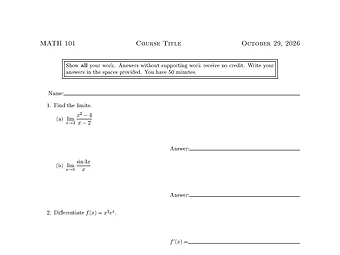
An exam paper with an instructions box, a name line, and answer spaces of set heights after each question, with the mathexam package.
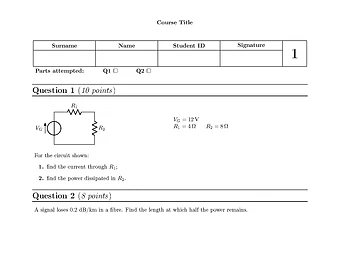
An exam paper with a boxed name and ID header, sections with points, and figure-plus-data blocks side by side, in cesenaexam.
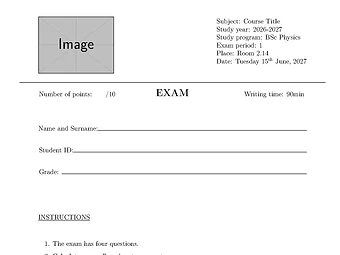
An exam with a cover page of subject, programme, date, duration and instructions, then questions with points and answer lines, in exam-lite.
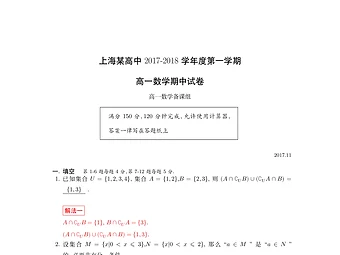
Bao Hongchang's BHCexam class (1.8) for Chinese secondary-school mathematics exam papers in the national layout: multiple-choice questions with options aligned to a grid, fill-in-the-blank lines sized to the answer, short-answer questions with sub-questions and scores, optional answer key and two-column mode; teacher copy (with answers) and student copy. XeLaTeX with ctex.

Cameron Gray's bangorexam class (1.6.0), used by Bangor University's computer science department since 2016/17 for its examination papers: bilingual English/Welsh cover with school, module, exam period, time allowed and calculator/notes rules; compulsory Section A and n-from Section B (or single-section papers), marks, multiple-choice questions and an examiner's copy with solutions via the answers option.
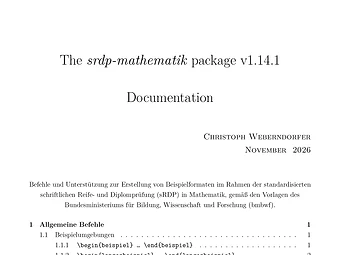
The srdp-mathematik package (1.14.1) for typesetting mathematics tasks in the layout of Austria's standardised school-leaving exam (SRDP, Zentralmatura): multiple-choice (1 aus 6, 2 aus 5), gap-fill (Lückentext), matching and open formats with answer key on or off and grading tables; the sample is the package's German showcase of every task type.
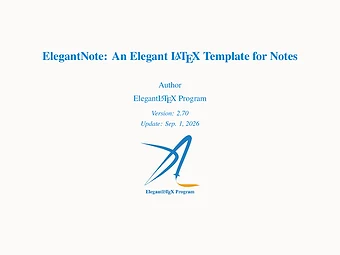
The ElegantLaTeX group's elegantnote class (2.70, 2026) for lecture and study notes, with its English guide as the sample: title block, colour themes (here 'hazy' and blue), screen and print modes, coloured theorem, definition and proof environments, lists, listings, a figure and tables; pdfLaTeX.
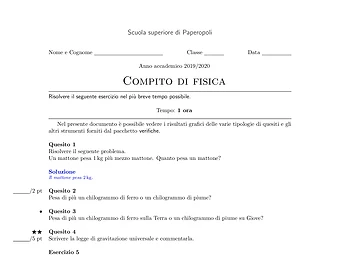
Italian school test (verifiche)
TeachingFrancesco Raccanello's verifiche package (9.4) for Italian secondary-school tests (verifiche): heading with school, year, duration and instructions, exercises, true/false and multiple-choice questions, open questions with answer lines, points and solutions that can be shown in colour or hidden; the example is in Italian.
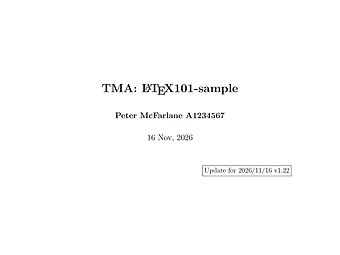
G. I. Riley's ou-tma package (1.22) for answering Open University tutor-marked assignments (TMAs): your name, personal identifier, module and TMA number in the header, questions numbered like 1(b)(iii) or 1(ii)(c), marks and cross-references; the sample TMA explains each option as it goes.
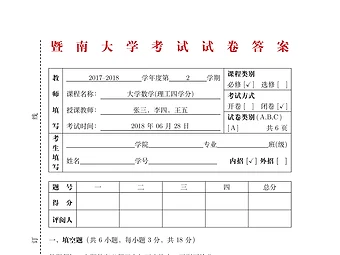
Jianrui Lyu's jnuexam class (2024F) for Jinan University examination papers in A3 or A4: header table with year, term, course and teachers, binding line, scratch paper, multiple-choice, fill-in and worked questions with scores, answer key on or off, and randomised question order for a B paper from a seed; Chinese example (main) and English example. XeLaTeX.
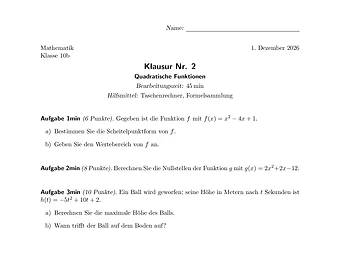
K. Wehr's schulmathematik bundle (1.7.1) for German-speaking mathematics and physics teachers; the sample uses its Klausur class: course, date and number of the test, working time and permitted aids in the header, numbered tasks with points and sub-tasks, and solutions kept in the same file that print as an answer key with the MusterloesungD option (or as beamer slides with Musterloesung). The bundle also has classes for worksheets, competence lists, oral Abitur exams and presentations.
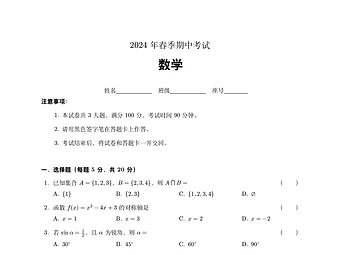
The exam-zh class for Chinese examination papers, with its first complete example (a mathematics mid-term in Chinese): title and subject, name fields, notice to candidates, multiple-choice questions with answer parentheses, fill-in blanks, and worked problems with points and step scores; XeLaTeX with the Fandol fonts.
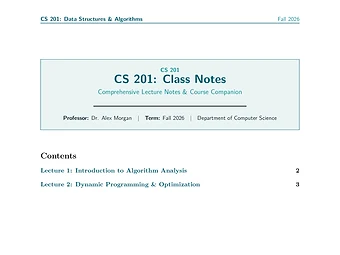
The modernclassnotes class (1.1.0) for lecturers and students, with four modes and colour palettes: complete course notes (main file), a one-lecture handout with a metadata banner, a homework worksheet with student fields and solutions that can be hidden, and chapter notes, with definition, theorem, example and remark boxes.
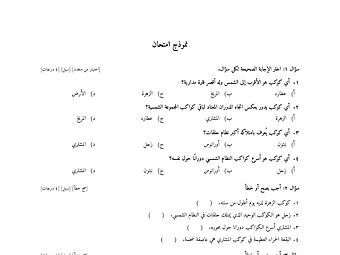
Nadeer Aljaroudi's exam-rtl package (1.0) for exams in Arabic: eight question types (multiple choice, true/false, fill in the blank, ordering, matching, essay, short answer, reading passage) with marks, difficulty and type labels, Eastern Arabic numerals, reproducible shuffling of options from an exam id, and a student mode and a teacher mode that prints the answers. XeLaTeX with polyglossia.
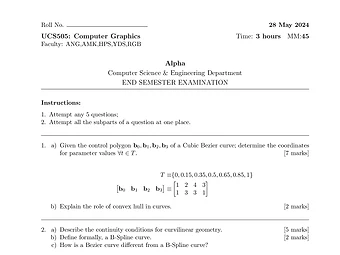
Raghav B. Venkataramaiyer's tiet-question-paper class for end-semester question papers at the Thapar Institute of Engineering and Technology (TIET), adaptable to any institution: header with department, exam, course code and name, duration, maximum marks and faculty initials, instructions and questions with sub-parts and marks.
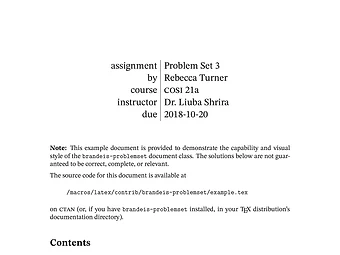
Rebecca Turner's brandeis-problemset class (0.5.5) for COSI problem sets at Brandeis University, usable for any computer science course: title block with course, instructor, due date and set number, problems and answers, pseudocode, assembly and Scheme listings, Gantt charts and STIX 2 fonts; the example is a worked operating-systems problem set. XeLaTeX.

The ugentcourse class from ugentdocs for course notes (syllabi in the Flemish sense) in Ghent University's 2025 house style: front and back covers with faculty colours, cover image and partner logos, authors, chapters, two-sided layout, figures, tables and biblatex author-year references (biber); the sample is in Dutch (language option for English).
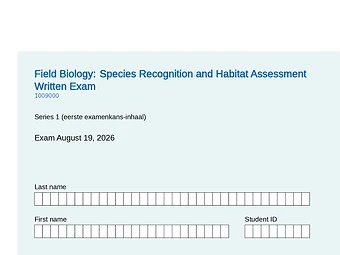
The ugentexam class from ugentdocs in Ghent University's 2025 house style: a cover page with course, academic year, examiners and faculty colours (optional full-colour cover background), exam instructions, numbered questions with points and answer space, Dutch or English; the English sample exam on population ecology. LuaLaTeX with Arimo in place of the UGent Panno font.
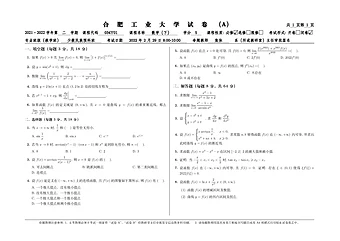
Shenxing Zhang's hfutexam class (1.10) for Hefei University of Technology examination papers: the A3 two-column exam paper with year, term, course code and name, credits, course type, exam form, class, date and setter in the header (main), the answer sheet (datizhi), the reference answers with scores (cankaodaan), and a simple A4 layout. XeLaTeX with ctex.
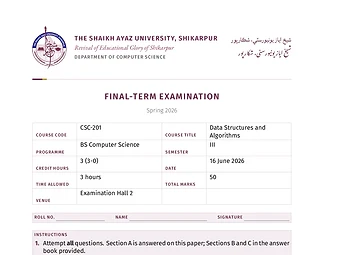
The Shaikh Ayaz University's examination paper class for mid-term, final-term, sessional and make-up papers: header with course, time and marks, instructions, numbered questions with marks; a final-term demo paper and a starter.
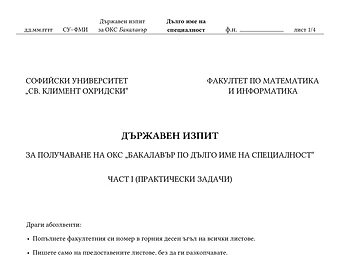
A Bulgarian LaTeX class for typesetting the practical part (Part I, problems) of the bachelor's state examination at the Faculty of Mathematics and Informatics of Sofia University St. Kliment Ohridski: title page with the university and faculty, the degree programme (\spec), date and the instructions to candidates; each problem on its own page from a separate file under problems/ (\problem), with a field for the faculty number and page numbers 'page X of Y'; a draft page; Linux Libertine with Cyrillic, listings for code. Each problem file is a standalone document that can also be compiled on its own (then with solutions).
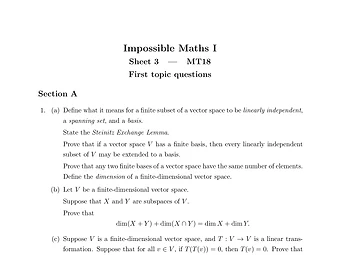
The problem-sheet class the Mathematical Institute uses for its undergraduate courses (Keith Gillow, v1.7, 2021), built on the standard exam class: header with Oxford term, course, sheet number and sheet title, contact line in the footer, 12 pt A4 with 1.25 line spread, questions with parts and subparts, and solutions that print or hide by class option (default, noanswers, allanswers, or tutorversion with a 'not for students' warning). The main sample is the sectioned sheet (optional warm-up section with worked answers, main questions, optional extension section); the standard four-question linear-algebra sheet is included as a second example.
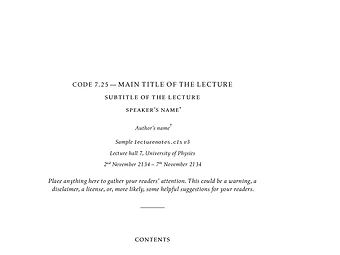
V. H. Belvadi's lecturenotes class (v3.2) for notes of a lecture course, a seminar or a talk: a header block with course code, subject, speaker, dates, place and an attention box, contents, numbered lectures with dates in the margin, margin notes, equations and theorem environments; the class's sample in the 'course' layout. LuaLaTeX.