Grant LaTeX templates
Every template compiles as it stands, from the publisher’s own package. Type your journal’s name below, browse by journal, or see conferences and their deadlines.
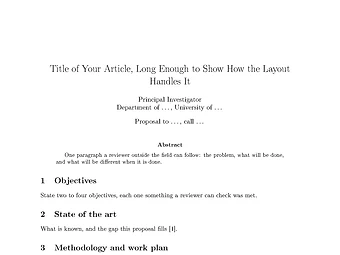
Objectives, state of the art, work packages and references — the general shape of a proposal.
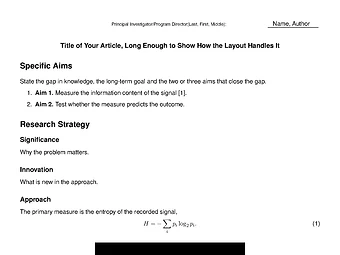
The research plan of a US National Institutes of Health grant application on the nih class, with the PHS 398 continuation-page headers and footers.
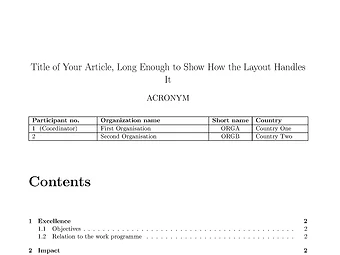
The technical annex of an EU Horizon 2020 research and innovation proposal on h2020proposal, which builds the participants table, work-package tables and deliverable lists from commands.
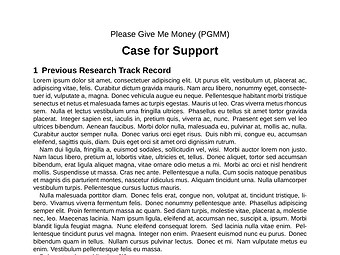
Achim D. Brucker's epsrc class for Engineering and Physical Sciences Research Council attachments (case for support, track record, workplan, justification of resources) in 11 pt Arimo, the free Arial metric clone, with 2 cm margins, shared project details in epsrc.config and applicant publications highlighted in the biblatex references.
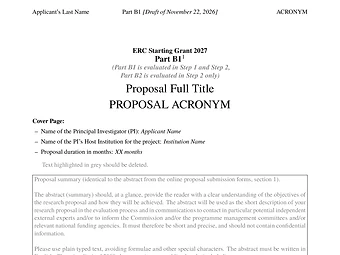
Alexandru Fikl's erc-stg class after the ERC's 2026 Starting Grant templates, with Part B1 (extended synopsis, CV and track record) and Part B2 (scientific proposal), the page limits in the headings, and the host-institution letter and eligibility-extension request; \ercgrant switches it to a Consolidator Grant. LuaLaTeX with a tagged, accessible PDF; Times New Roman falls back to TeX Gyre Termes.
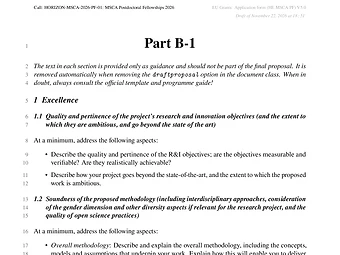
Alexandru Fikl's msca-pf class after the Marie Skłodowska-Curie Postdoctoral Fellowships Part B templates: Part B-1 (Excellence, Impact and Implementation within the 10-page limit, with a work-plan chart) and Part B-2 (CV, capacity of the host, ethics, letter of commitment). LuaLaTeX with a tagged, accessible PDF.
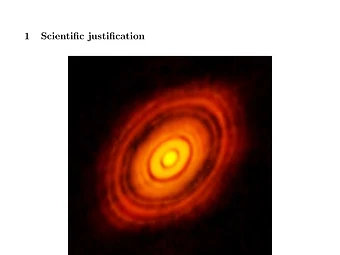
ALMA's LaTeX templates for the scientific justification attached in the Observing Tool, Cycle 13: the 4-page template for Regular, ToO, DDT, VLBI and Phased Array proposals with the HL Tau sample figure, and the 7-page Large Program template with its sample figure, 12 pt on A4.
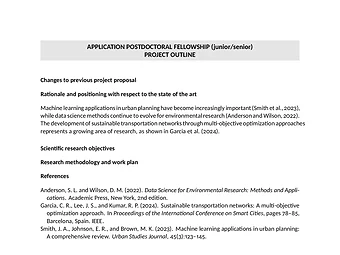
The project outline of the FWO junior or senior postdoctoral fellowship application in the layout the FWO prescribes for LaTeX users (Carlito 11, single spacing, 2.5 cm margins on A4): the grey title box, the mandatory headings (changes to a previous proposal, rationale and positioning, scientific research objectives, research methodology and work plan) with the FWO's explanatory paragraphs kept as comments, natbib author-year citations and a compact reference list.
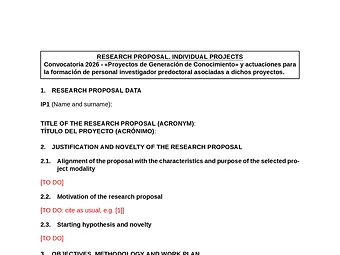
The scientific-technical report (Memoria Científico-Técnica) for the AEI call PID2026 'Proyectos de Generación de Conocimiento', individual projects of type A, B and RTA, following the official 2026 Word model and Annex VII: the memoriact class with English or Spanish headings (lang option), switches for the optional sections (Investigación Orientada priority, women's health, two PIs, interdisciplinarity, transfer plan, predoctoral grant, Annex IV), the call's reminders as comments, header and footer of the official model and a numbered bibliography.
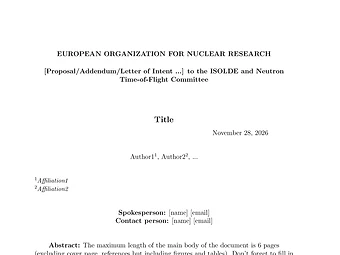
The INTC's LaTeX templates for documents to the ISOLDE and Neutron Time-of-Flight Committee: the ISOLDE proposal, addendum or letter of intent (cover block, abstract, physics case, experimental set-up, beam-time request, 6-page main body) with the appendices for the Technical Advisory Committee, and the n_TOF version.
The Chandra X-ray Center's LaTeX templates for Cycle 28: the Science Justification and Technical Feasibility file (US Letter, 11 pt, one- or two-column layouts given as alternatives, joint-facility section, references on their own page) and the separate Team Expertise file.
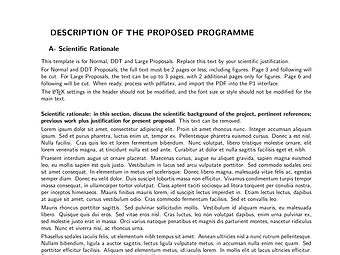
ESO's LaTeX templates for the PDFs imported into the p1 proposal interface: the scientific rationale and immediate objective for Normal, DDT and Large Programmes (2 pages, or 3 plus 2 of figures for Large Programmes) with two sample figures, and the Technical Specification report needed when a visitor instrument is requested.
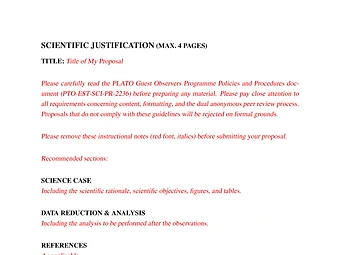
ESA's LaTeX templates for the PLATO Guest Observers Programme, first Announcement of Opportunity: the Scientific Justification (4 pages), the Technical Justification and Implementation, and the Team Expertise and Management Plan, in 12 pt Times on A4 with the instructions in red italics to remove before submission.
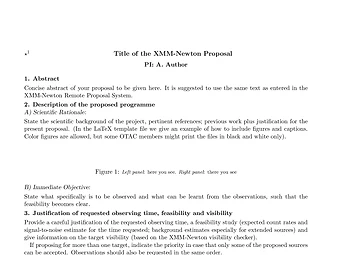
The XMM-Newton User Support Group's LaTeX form for proposal scientific justifications, which the SOC strongly recommends: scientific rationale, immediate objective (with the OM filter-wheel note), justification of the requested observing time, and the report on previous XMM-Newton work and publications, 11 pt, single or two columns.

Fei Qi's mynsfc class (2.00, in TeX Live) for the main text (正文) of National Natural Science Foundation of China proposals, with its example: \nsfcpart and \nsfcsection produce the official headings of the 2026 General Program format, with tables, figures and a biblatex list of the applicant's publications; Chinese, XeLaTeX with the free Fandol fonts.
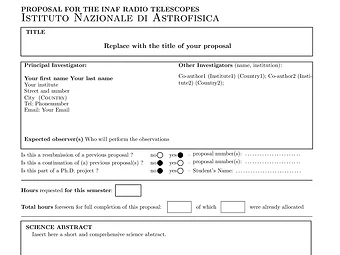
INAF's LaTeX submission form for observing time on the Italian radio telescopes (Sardinia Radio Telescope, Medicina and Noto), on the radioprop style after IRAM's proposal style: PI and co-author fields, observer, resubmission and student fields, requested hours, scientific and outreach abstracts, then the scientific and technical justification.
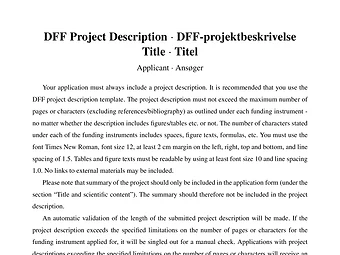
DFF's own LaTeX template for the project description of its applications: A4, 12 pt Times, 2 cm margins and the 1.5 line spacing DFF requires (matched to Word's), title and applicant block, and DFF's instructions in English and Danish on length, fonts, figures, references as a separate annex and the e-grant character count, to be deleted before writing.
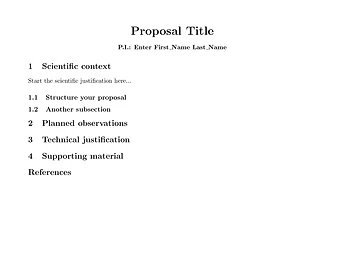
IRAM's LaTeX template for the scientific and technical justification uploaded to its proposal system for NOEMA and the 30-meter telescope: 2 pages of text (4 for Large Programs) plus 2 pages of figures, tables and references, 11 pt or larger, with the sections Large Programs must include.
Gemini's LaTeX templates for the PDF attachments of a Phase I Tool proposal, semester 2027A: Attachment 1 (scientific justification, with anonymity notes) and Attachment 2 (experimental design and technical description), the Large and Long Program attachments, and the Fast Turnaround dual-anonymous attachment, all on the semester's style file.
A small KOMA-Script class for UK Research and Innovation proposal attachments in 11 pt Arial-metric type with 2 cm margins and tightened headings, with three documents: case for support (case.tex, the main file), workplan and justification of resources; biblatex with references unique across separate bibliographies. LuaLaTeX.

Liang-Ting Chen's nstc-proposal classes (1.1, in TeX Live) reproducing the layouts of Taiwan's National Science and Technology Council proposal forms, with their examples: CM03 research plan (proposal.tex, the main file, with the form's section texts), CM302 publication list (bibliography.tex) and the progress/final report (report.tex); Chinese or English, with the free AR PL KaitiM Big5 font when BiauKai is absent.
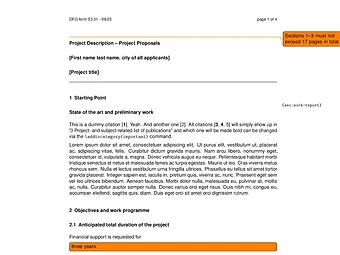
Martin Hölzer's DFG template after form 53.01 (03/24) for individual research grants, in English (dfg.tex) and German (dfg-german.tex): project description with the page-limit notes, work packages, a pgfgantt schedule, bold author highlighting in the publication lists (biber), and CVs after form 53.200 (CV-dfg.tex, CV-dfg-german.tex).
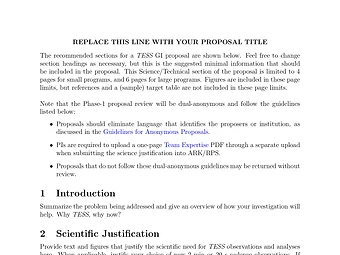
The TESS GI Office's LaTeX templates for the Guest Investigator Program, Cycle 9: the science justification and technical feasibility template for Small, Large and Key proposals, the Mini proposal template, and the one-page Team Expertise upload, US Letter, 12 pt, with the dual-anonymous instructions.
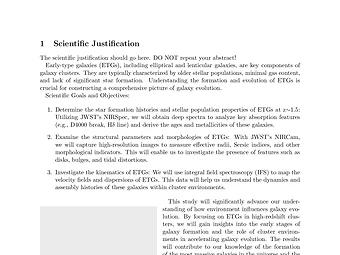
NRAO's optional LaTeX template for the scientific justification of Regular, Large and DDT proposals for the VLA, VLBA and Green Bank Telescope (11 pt minimum, one-inch margins, US Letter, page limits in the header), with a sample justification and wrapped figure; NRAO's Plan of Dissertation Research template for students is included.
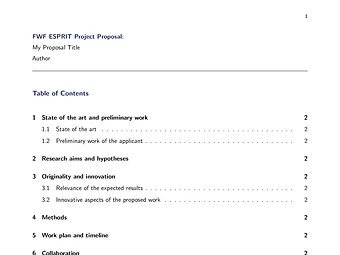
A proposal template for the Austrian Science Fund's ESPRIT programme, adaptable to other FWF calls: title block, table of contents, the ESPRIT sections (state of the art and preliminary work, aims and hypotheses, originality and innovation, methods, work plan and timeline with a pgfgantt chart, collaboration, qualifications, ethical and gender aspects, research institution), work-package summary boxes and the cited literature as an annex, in FWF blue; a fork of the DFG proposal template already in the gallery.
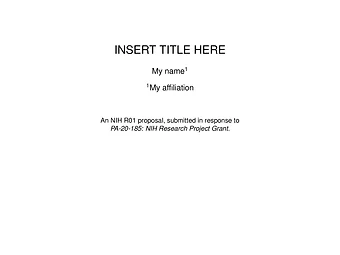
The Noble Lab's NIH R01 template (used for several submitted applications): the parts of the application in one file (PHS assignment request, project summary, project narrative, specific aims, research strategy with significance, innovation and an approach laid out aim by aim, bibliography, resource, data sharing and software dissemination plans, equipment, budget justification and resources), each with NIH's instructions in small capitals that one line in the preamble switches off before submission; Helvetica, 12 pt, half-inch margins. Split the PDF into the separate uploads at the end.
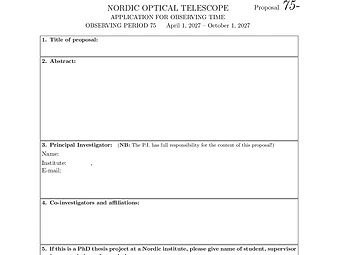
The NOT's required LaTeX proposal package for Period 75 (April-October 2027): the normal-proposal and large-proposal (more than 15 nights) templates with their style files, covering PI and co-investigators, instruments and observing modes, targets, scheduling, scientific justification and technical details; proposals are compiled automatically with pdfLaTeX.
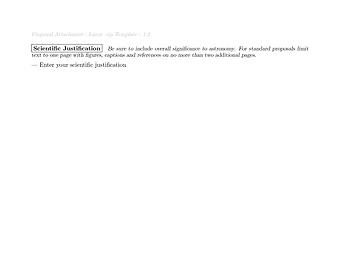
NOIRLab's LaTeX templates (by Chadd Myers) for the two PDF attachments of a NOIRLab proposal to the Kitt Peak, Cerro Tololo, Gemini-shared and community-access telescopes: the standard and survey proposal attachments (scientific justification, experimental design, technical description), the resource proposal, the team information and relevant background attachment, and the NN-EXPLORE Key Program attachments, each with its own style file, 11 pt.
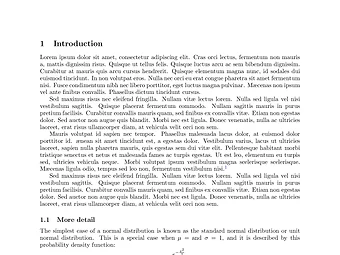
Three plain LaTeX samples published in NSF's nsf-open GitHub organisation by a volunteer group of NSF program officers, tested to upload to Research.gov: 11 pt article and amsart layouts with one-inch margins, unnumbered section headings, PDF metadata and the PAPPG font rules explained in the comments. The main file is nsf-sample-1.tex; nsf-sample-2.tex and nsf-sample-3.tex are alternatives.
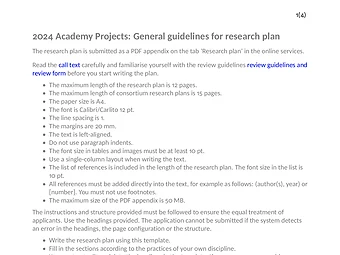
The Research Council of Finland's own LaTeX research plan templates, preset to its rules (Carlito 12 pt, single spacing, 20 mm margins, page x(y) numbering, prescribed headings that its upload check verifies) with the instructions for each section in grey: the Academy Project plan is the main file, and the same project holds the plans for Academy Research Fellow, Clinical Researcher, Sport Sciences, Development Research, Antarctic Research, HPC, Proof of Concept and the Strategic Research Council's letter of intent and full application.
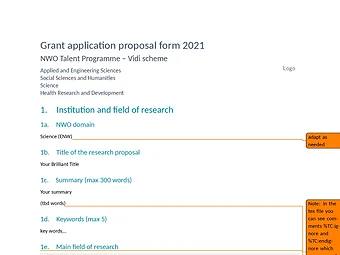
Roelof Rietbroek's template after the Dutch Research Council's Vidi application form of the 2021 round: every section of the form with its word and page limits in the heading (for example, proposed research max. 4,000 words or 8 pages), a work-plan Gantt chart and natbib references, in Carlito (the free metric match for Calibri). LuaLaTeX.
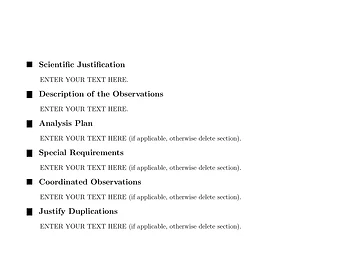
STScI's own LaTeX templates for the PDF attachment of a Hubble Phase I proposal, Cycle 34 and beyond: the General Observer and Snapshot template, the Archival Research and Theory template and the Director's Discretionary template, each with the required section headings filled in by the style file. STScI disqualifies proposals that change the template's fonts or margins.
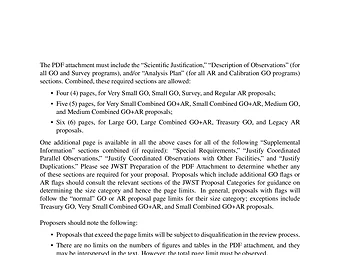
STScI's own LaTeX template for the PDF attachment of a JWST Cycle 6 General Observer, Survey or Archival Research proposal: Scientific Justification, Description of Observations, Analysis Plan and the supplemental sections, with the page limits for each proposal size; the Director's Discretionary template is included. STScI disqualifies proposals that change the template's formatting.
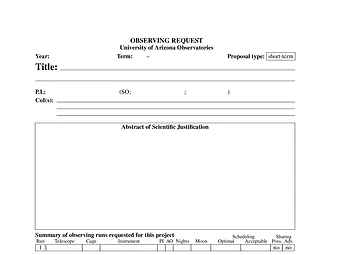
Steward Observatory's soprop class and template, required for proposals to the University of Arizona Observatories (MMT, LBT, Magellan, Bok, Kuiper and the other UAO telescopes): the cover page built from the PI, telescope, instrument, run and scheduling fields, page-limit checks with warnings for empty fields, and the scientific justification, feasibility, time request and past-use sections.
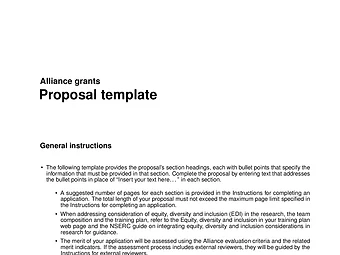
Sylvain Hallé's nserc-alliance class, which reproduces NSERC's Word template for the Alliance grant proposal: English or French title page, the official section headings with their instruction bullets (hidden with the nobullets option), applicant and partner details in application-config.tex, and natbib references.
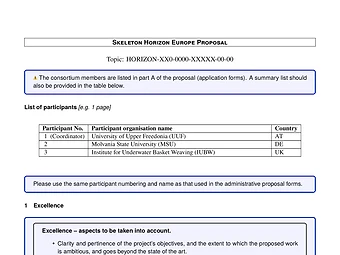
Tristan Miller's heria class (in TeX Live), a LaTeX conversion of the official Horizon Europe Part B template (version 5.1) for Research and Innovation Actions and Innovation Actions, with its skeleton proposal: the official headings and instructions of Excellence, Impact and Implementation, and the participant, work-package, deliverable, milestone, risk, staff-effort and cost tables generated from the data you enter.
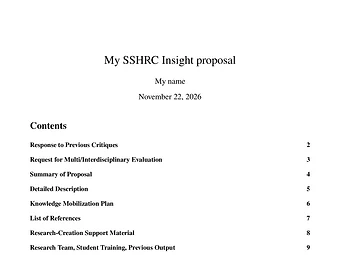
Tristan Miller's sshrc-insight class (in TeX Live) formatted to SSHRC's specifications, with its skeleton proposal: one file per attachment and long-answer field (summary, detailed description, expected outcomes, knowledge mobilization plan, research team, previous critiques, budget justification, references and more), compiled together as one PDF with a table of contents or each on its own, with consistent biblatex citation numbers and character counts; English or French.
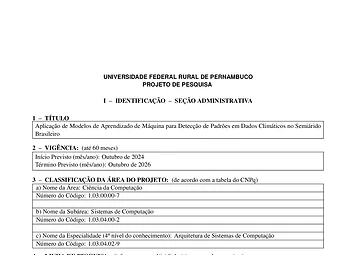
The projetodepesquisa class (KOMA-Script) for research projects registered at the Universidade Federal Rural de Pernambuco, following Annex I of Resolução CEPE/UFRPE nº 361/2021: an administrative part (title, term, CNPq areas, research lines, keywords, research group, participants table with roles and hours) and a scientific part (abstract, introduction, objectives, method, a landscape activity schedule, expected results and references), with Times-style type.
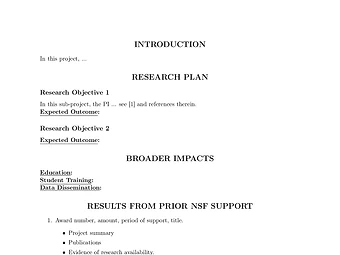
Yimin Zhong's NSF template after PAPPG NSF 24-1: every Research.gov upload is its own file sharing one preamble (subfiles), namely Project Summary, Project Description (15-page limit noted), References Cited, Budget Justification, Data Management Plan, Mentoring Plan, Facilities and synergistic activities, in 11 pt with one-inch margins. The main file is the Project Description; compile any other part by making it the main file.